Gelatide Official Website › Blog › Two caffeine sources
Two Caffeine Sources On One Label, And No Total
Guarana seed and green tea leaf both carry caffeine, both are on this label, and no combined total is printed anywhere. Why that one missing number matters more than the rest.
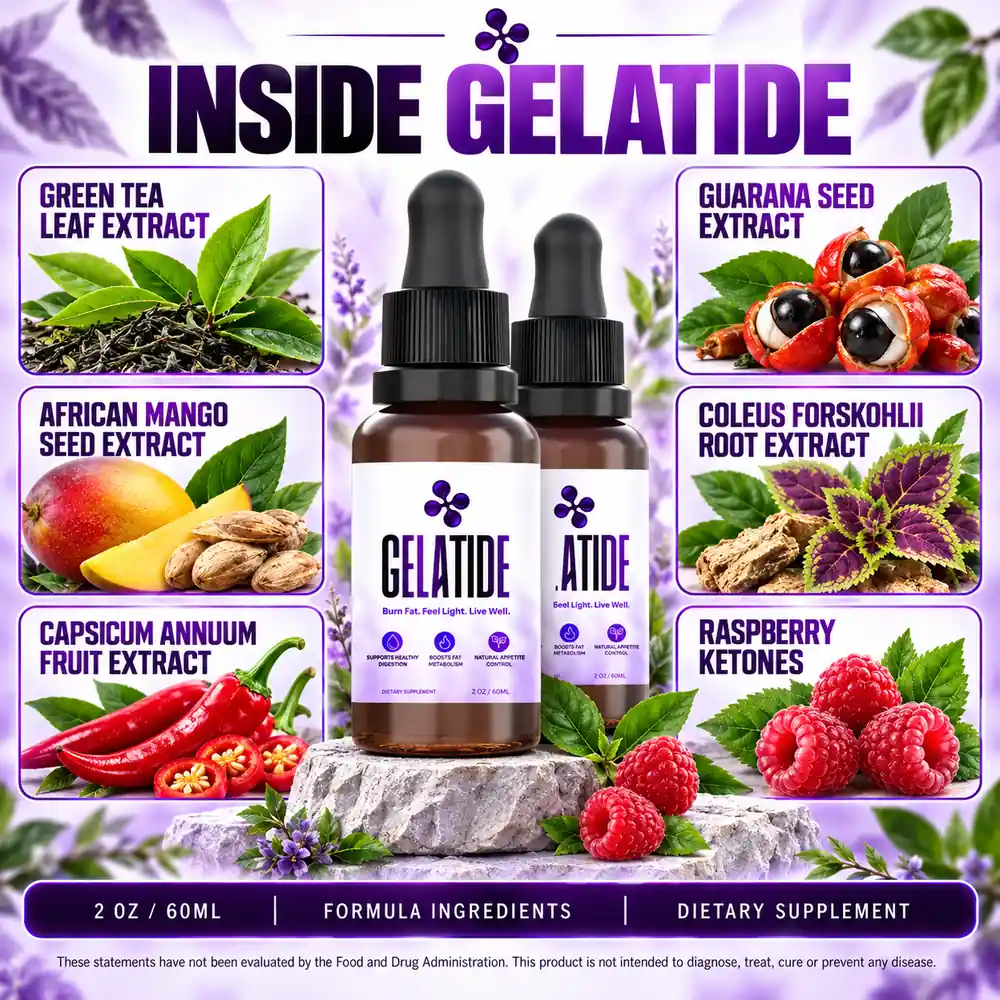
- Two ingredients here carry caffeine. Guarana seed extract and green tea leaf extract.
- Guarana is the concentrated one. Roughly two to four times the caffeine of coffee bean by weight.
- No total is printed. Not on the bottle, not on the artwork, not in the material supplied to this desk.
- That total is cheap to measure and reveals nothing about the formula. Which makes its absence a decision rather than an oversight.
- It matters most for blood pressure and medication. Both are things a pharmacist could advise on, given a number.
General information, not medical advice. Gelatide is a dietary supplement for healthy adults aged 18 and over. It is not a drug, it is not FDA-approved, and it is not intended to diagnose, treat, cure or prevent any disease. Two of its six botanicals carry caffeine and no total is printed, so if you take prescription medicine, manage blood pressure, or have a thyroid or liver condition, speak to a clinician or a pharmacist before adding it to anything.
Which ingredients on this label carry caffeine
Gelatide names six botanical extracts. Two of them are caffeine plants and neither is described that way on the artwork.
- Guarana (Paullinia cupana) seed extract. A South American climbing plant whose seeds are among the most caffeine-dense plant materials in commercial use.
- Green tea (Camellia sinensis) leaf extract. The same plant as black and oolong tea, processed differently. Caffeine content of an extract varies with how it is made.
The other four, African mango seed, Coleus forskohlii root, capsicum annuum fruit and raspberry ketone, do not carry caffeine. So the stimulant load in this bottle comes from two sources, stacking, with no figure printed for either and no combined total anywhere.
This is worth knowing because caffeine plants are rarely labelled as caffeine on the front of a bottle. Green coffee bean, yerba mate and kola nut belong on the same list. A buyer scanning an ingredient panel for the word “caffeine” will not find it on most products in this category, including this one.
How much caffeine guarana actually carries
Guarana seed runs at roughly two to four times the caffeine content of coffee bean by weight. That is the figure the literature generally reports and it is the reason guarana appears in energy drinks rather than in herbal teas.
What it does in trials is mostly what caffeine does, with one interesting caveat. A randomised cycling trial published in 2024 compared guarana against a matched low dose of plain caffeine and against placebo. Guarana improved time-trial performance; the matched caffeine dose did not. The authors read that as a hint that something beyond the caffeine may contribute, and a hint is what it remains.
A randomised trial in patients undergoing chemotherapy found guarana reduced fatigue against placebo, using 50 to 75 mg of dried extract a day. That is a real clinical finding in a specific population and it is not an appetite or a weight finding.
| Ingredient | Caffeine | What the trials used | Printed in Gelatide |
|---|---|---|---|
| Guarana seed extract | Roughly 2–4x coffee bean by weight | 50–75 mg dried extract a day in the fatigue trial | not published |
| Green tea leaf extract | Present; varies with extract process | 270–1,200 mg catechins a day in the pooled trials | not published |
| Combined total | — | — | not published |
Three rows and three blanks in the right-hand column. The third row is the one that matters most and it is the one no document from this seller answers.
What caffeine does, and why it feels like the product working
Caffeine is the most reliably active compound in this entire product category, and it is worth being clear about why that creates an interpretive problem rather than a benefit.
Within an hour of taking it, caffeine raises alertness, lowers perceived effort during physical activity, and can blunt appetite transiently in some people. Those are real, well-characterised effects. They are also exactly the effects a buyer of a metabolism supplement is hoping for, and they arrive fast enough to feel causal.
The meta-analysis of green tea catechins is instructive here. It found catechins with caffeine produced a small reduction in body weight and waist circumference, and the waist effect lost statistical significance once caffeine was controlled for in the comparison. When you take the caffeine out of the analysis, part of the effect goes with it.
So a person taking this product may well notice something in the first week. What they will not be able to establish is which of the six botanicals, if any, was responsible, because the fastest-acting component is present in unknown quantity from two directions at once.
Gelatide, from a desk that publishes the caffeine problem
Six botanicals, two of them caffeine-bearing, and no total printed. That is on the product page as well as in this article. $294 for six bottles, 60 days to change your mind.
$49 to $79 a bottle · 60-day money-back window
Order GelatideBlood pressure, and who should care about this
A critical review of caffeine and blood pressure in Nutrition Research Reviews summarises what is well established: caffeine produces an acute pressor effect, larger in people who do not consume it habitually, and clinically relevant for anybody managing hypertension.
That population overlaps heavily with the people who shop in this category, which is the whole reason this article exists. If you are managing blood pressure, an unquantified caffeine source is a genuinely awkward thing to add, and the awkwardness is not resolved by the ingredient being botanical.
There is a second complication specific to this label. Coleus forskohlii is also on it, and forskolin is a vasodilator that lowers blood pressure. So this bottle contains one ingredient pushing blood pressure up acutely and another pushing it down, with no amount printed for either. For a healthy adult that is unlikely to matter. For somebody being medically managed it is an unpredictable addition, and unpredictable is the word a clinician will react to.
The interactions worth asking a pharmacist about
MedlinePlus maintains a plain-language page on caffeine and it is a better ten-minute read than anything a supplement seller will write, including this. The categories worth raising:
- Stimulant medication. The effects add.
- Some asthma medication. Theophylline is chemically related to caffeine.
- Some antibiotics. Certain classes slow caffeine clearance, which effectively raises the dose.
- Lithium. Caffeine intake affects lithium levels, and changes in intake matter as much as the intake itself.
- Blood pressure medication. As above, and complicated further by the forskolin on the same label.
- Anything for a thyroid condition. Worth raising, because stimulant load and thyroid symptoms interact in ways that are easy to misattribute.
NCCIH summarises the safety picture for green tea separately, and it covers a second issue that is not about caffeine at all: concentrated green tea extract has a liver-injury case history that brewed tea does not. That is set out on the Gelatide safety page.
The single most useful sentence to say to a pharmacist about this product is “it contains two caffeine-bearing botanicals and the label prints no amounts.” That tells them everything they need to know about what kind of advice they can give.
Why a total caffeine figure is not printed
Only the manufacturer can answer that, and this desk is not going to guess at a motive. What it can do is take the usual explanation seriously and see how far it gets.
The usual explanation for withholding label detail is competitive: publishing a full panel invites a rival to copy the formula. For extract ratios and individual ingredient amounts that argument has some force, even if a determined competitor could have the product assayed for a few hundred dollars anyway.
It does not work for a caffeine total. A single combined figure reveals nothing about how the formula is built, because caffeine comes from two named ingredients whose ratio it would not disclose. It is a routine and inexpensive assay. And it is the one number that would let a caffeine-sensitive buyer decide safely and a pharmacist advise properly.
So the absence of that one figure is the part that is hardest to explain on commercial grounds, and this desk says so on the testing and quality page as well as here.
What to do if you are buying it anyway
- Take it in the morning. Not the evening. Disturbed sleep undoes anything a metabolism product might be doing for you, and it is the most commonly reported caffeine effect.
- Count your existing intake first. Coffee, tea, energy drinks, pre-workout. You are adding an unknown to a known, and you should at least know the known.
- Reduce something on the days you take it, at least for the first week, if you are already at the upper end of your usual intake.
- Stop if you get jitteriness or palpitations, and say so to a clinician rather than pushing through. That is a dose signal.
- Take the bottle to a pharmacist if you take anything at all. Five minutes, free, and specific to you in a way this article cannot be.
- Use the guarantee if it does not suit you. Sixty days, and the details are on the refund policy page.
Sources cited in this article
- De Giuseppe R, Di Napoli I, Granata F, Mottolese A, Cena H. Caffeine and blood pressure: a critical review perspective. Nutr Res Rev. 2019;32(2):169-175. https://pubmed.ncbi.nlm.nih.gov/30947761/
- MedlinePlus. Caffeine. U.S. National Library of Medicine. https://medlineplus.gov/caffeine.html
- Penna EM, Coelho DB, Maia-Lima A, et al. Guarana (Paullinia cupana) but not low-dose caffeine improves cycling time-trial performance versus placebo. Int J Sport Nutr Exerc Metab. 2024;34(1):30-37. https://pubmed.ncbi.nlm.nih.gov/37898479/
- de Oliveira Campos MP, Riechelmann R, Martins LC, Hassan BJ, Casa FB, Del Giglio A. Guarana (Paullinia cupana) improves fatigue in breast cancer patients undergoing systemic chemotherapy. J Altern Complement Med. 2011;17(6):505-12. https://pubmed.ncbi.nlm.nih.gov/21612429/
- Phung OJ, Baker WL, Matthews LJ, Lanosa M, Thorne A, Coleman CI. Effect of green tea catechins with or without caffeine on anthropometric measures: a systematic review and meta-analysis. Am J Clin Nutr. 2010;91(1):73-81. https://pubmed.ncbi.nlm.nih.gov/19906797/
- National Center for Complementary and Integrative Health. Green Tea: Usefulness and Safety. https://www.nccih.nih.gov/health/green-tea

Every page, every journal post, the bottle facts and the ingredients go through review by Dr. Kia Mitchell, MD before they ship. We write from the printed Gelatide bottle and the seller’s own listing artwork, cite public research beside the amount that research actually used, and print “not published” wherever a figure is not disclosed rather than estimating it. This label names six botanicals and publishes an amount for none of them, and that fact appears in every article that names one. Every PubMed record here was confirmed through the NCBI summary interface before it was written down. Corrections are made on the page itself and the review date moves forward. Write to [email protected]. Last updated September 17, 2026.