Gelatide Official Website › Reference guides
Reference Guides: Reading A Metabolism Supplement Label
Two guides, written to be useful whether or not you buy anything from this website. The first explains what a metabolism supplement label is required to tell you and what it is allowed to leave out. The second is a nine-point checklist for judging one, scored against the product this desk sells.
These are the two pages here that are not about selling a bottle. They carry ordinary headings and they are written to survive being read by somebody who buys a competitor.
What each guide covers
One explains the category. The other gives you a way to judge anything in it, including what is sold here.
The metabolism supplement guide
What the category is, what the ingredients that keep appearing in it actually do, how much of an effect the research supports, and the difference between a claim a label may legally print and a claim it can support. Roughly a fifteen-minute read. Read it.
Why a retailer publishes a checklist its own product fails
There is an obvious objection to a seller writing a buying guide, and it is the right objection: the guide will be written backwards from the product, with nine criteria the product happens to meet.
The test of whether that has happened is simple. Read the scorecard at the end of the second guide. If the product passes every line, the checklist was written to fit it. On that scorecard the product sold here scores four out of nine, and the five failures are printed in the same typeface as the four passes.
That is not modesty. It is the only way a guide published by a retailer can be worth anything at all, and it is the same reasoning behind the label page, which prints twelve rows and eleven blanks, and the reviews page, which publishes the three-star complaints in full.
Where the conflict sits. Gelatidefit earns money on orders placed through this website. Both guides were written knowing that, and the honest way to handle it is to write things a competitor could quote against us, then publish them anyway. Judge these two pages on whether they do that.
The shortest useful version
Those five will get you further than any amount of reading about individual botanicals, because they are questions about the label rather than about biology, and a label is the only thing you have in front of you in a shop or on a product page. Four of the five can be answered without leaving the page you are already on.
The fifth, comparing a dose against a trial, takes a minute longer and it is the one that decides most purchases. If a label prints 40 mg of something and the research used 500 mg, you have learnt more in that minute than a page of marketing copy could tell you. And if the label prints no figure at all, you have learnt something more useful still: the comparison cannot be made, by you or by anyone, and the product is asking to be taken on trust.
That is the position this website is in about the product it sells, and it is stated on every page rather than only here. Whether it is a reason not to buy is a judgement for the buyer. Whether it should be hidden is not a judgement at all.
- ✓Look for a milligram figure against every ingredient. If it is not there, nothing else on the label can be checked and no research can be attached to the product.
- ✓Count the caffeine sources. Guarana, green tea, green coffee, yerba mate and kola nut all carry it, and a label with two of them and no total is a label you cannot dose safely.
- ✓Compare against the trial dose, not against the bottle next to it. The NIH fact sheet on weight-loss supplements is organised by ingredient and it is the right reference.
- ✓Read the refund terms before the ingredient list. Who pays return postage is the term most often buried, and on a product you cannot evaluate the refund window is the real protection.
- ✓Assume weeks, not days. The trials in this category ran eight to twelve weeks. Anything promising a result by Friday is telling you something about itself.
How to read a supplement study without a science degree
Both guides quote research, and a reader is entitled to ask how much weight any given paper deserves. Four questions settle most of it, and none of them requires understanding the statistics.
- Was it in humans? A great deal of supplement marketing rests on cell-culture and rodent work. Those studies are real science and they are the wrong evidence for a decision about your own body, because the doses used in rodents are frequently enormous relative to body weight and the results often fail to replicate in people. Raspberry ketone is the clean example: the literature is genuine and it is entirely pre-clinical.
- Was there a control group, and were people randomised into it? Without one, a study measures the passage of time, the placebo effect and the enthusiasm of volunteers who signed up for a weight study. The phrase to look for is randomised controlled trial, usually abbreviated RCT.
- How many people, and for how long? Thirty people over twelve weeks is a pilot. It is worth something and it is not a basis for confidence. A great many of the ingredients in this category rest on exactly one study of about that size, and a systematic review that pools several small studies is more informative than any of them alone.
- What dose did they use? This is the question this whole website keeps returning to. A finding belongs to a dose. Without the dose it is a piece of interesting biology rather than a reason to buy anything.
Two practical habits follow from that. The first is to check the paper actually says what the page quoting it says: a PubMed identifier can be looked up in seconds, and this website lists a full citation for every source it uses. The second is to prefer a systematic review or a meta-analysis over a single trial where one exists, because a single trial is one result and a review is the shape of the whole literature. Where neither exists, that is itself the finding, and it should be reported as one rather than filled in with something weaker.
The NIH Office of Dietary Supplements fact sheet on weight-loss supplements is the best single starting point for anyone who wants to go further. It is organised by ingredient, it states the doses, and it is written by people with nothing to sell you.
Who writes these guides
This desk publishes what the bottle says and marks the gaps. The four claims below are the ones a sceptical reader can audit in ten minutes, which is the only reason to make them:
- The bottle is the source. The three support lines, the 2 fl oz volume, the liquid-drop format and the six ingredient names come from the printed label and the seller’s own listing artwork, not from a review column.
- The gaps are marked, never filled in. This label carries no amount for any of its six botanicals, no caffeine total and no serving size. Nothing undisclosed is estimated anywhere on this website, including in the structured data a machine reads.
- Sources are real and linked in the sentence. Every study cited here was confirmed against its PubMed record before it was written down, and the government pages were opened in a browser rather than assumed, because several of those hosts answer an automated request with a 404 that looks exactly like a dead link.
- Corrections change the date. Write to [email protected] and the review date at the foot of the page moves forward.
We earn when you buy. Gelatidefit is the Gelatide retail desk named at the top of this page, and this website makes money on orders placed through it. That is exactly why the missing-amounts table, the three-star reviews and the page explaining why the appetite claim is the thinnest of the three are here: they are where our interest and yours pull apart, and you should be able to watch us choose.
The desk on +1 (202) 604-0611 handles tracking, address changes, cancellations and refunds. It is not a sales line and this website never presents it as a way to place an order; orders go through the checkout only.
Every page, every journal post, the bottle facts and the ingredients go through review by Dr. Kia Mitchell, MD before they ship. We write these pages from the printed Gelatide bottle and the seller’s own listing artwork, cite public research for each of the six named botanicals, and print “not published” wherever a figure is not disclosed rather than estimating it. This label names six ingredients and prints an amount for none of them, and that fact appears on every page where an ingredient is named. Every study referenced here was checked against its PubMed record before it was written down, and the government pages were opened in a browser rather than assumed. Where the seller’s marketing claims more than the bottle supports, we say so on the page. Corrections are made on the page itself and the review date moves forward. Write to [email protected]. Last reviewed September 2026 by Dr. Kia Mitchell, MD.
Sources used across both guides
- National Institutes of Health, Office of Dietary Supplements. Dietary Supplements for Weight Loss: Fact Sheet for Health Professionals. https://ods.od.nih.gov/factsheets/WeightLoss-HealthProfessional/
- U.S. Food and Drug Administration. Structure/Function Claims. https://www.fda.gov/food/nutrition-food-labeling-and-critical-foods/structurefunction-claims
- U.S. Food and Drug Administration. Dietary Supplement Labeling Guide: Chapter VI. Claims. https://www.fda.gov/food/dietary-supplements-guidance-documents-regulatory-information/dietary-supplement-labeling-guide-chapter-vi-claims
- Federal Trade Commission. Health Products Compliance Guidance. December 2022. https://www.ftc.gov/business-guidance/resources/health-products-compliance-guidance
- United States Pharmacopeia. Dietary Supplements Verification Program. https://www.usp.org/verification-services/dietary-supplements-verification-program
- Batsis JA, Apolzan JW, Bagley PJ, et al. A systematic review of dietary supplements and alternative therapies for weight loss. Obesity (Silver Spring). 2021;29(7):1102-1113. https://pubmed.ncbi.nlm.nih.gov/34159755/
- Maunder A, Bessell E, Lauche R, Adams J, Sainsbury A, Fuller NR. Effectiveness of herbal medicines for weight loss: a systematic review and meta-analysis of randomized controlled trials. Diabetes Obes Metab. 2020;22(6):891-903. https://pubmed.ncbi.nlm.nih.gov/31984610/
- National Institute of Diabetes and Digestive and Kidney Diseases. Prescription Medications to Treat Overweight and Obesity. https://www.niddk.nih.gov/health-information/weight-management/prescription-medications-treat-overweight-obesity
Or go straight to the product this desk sells
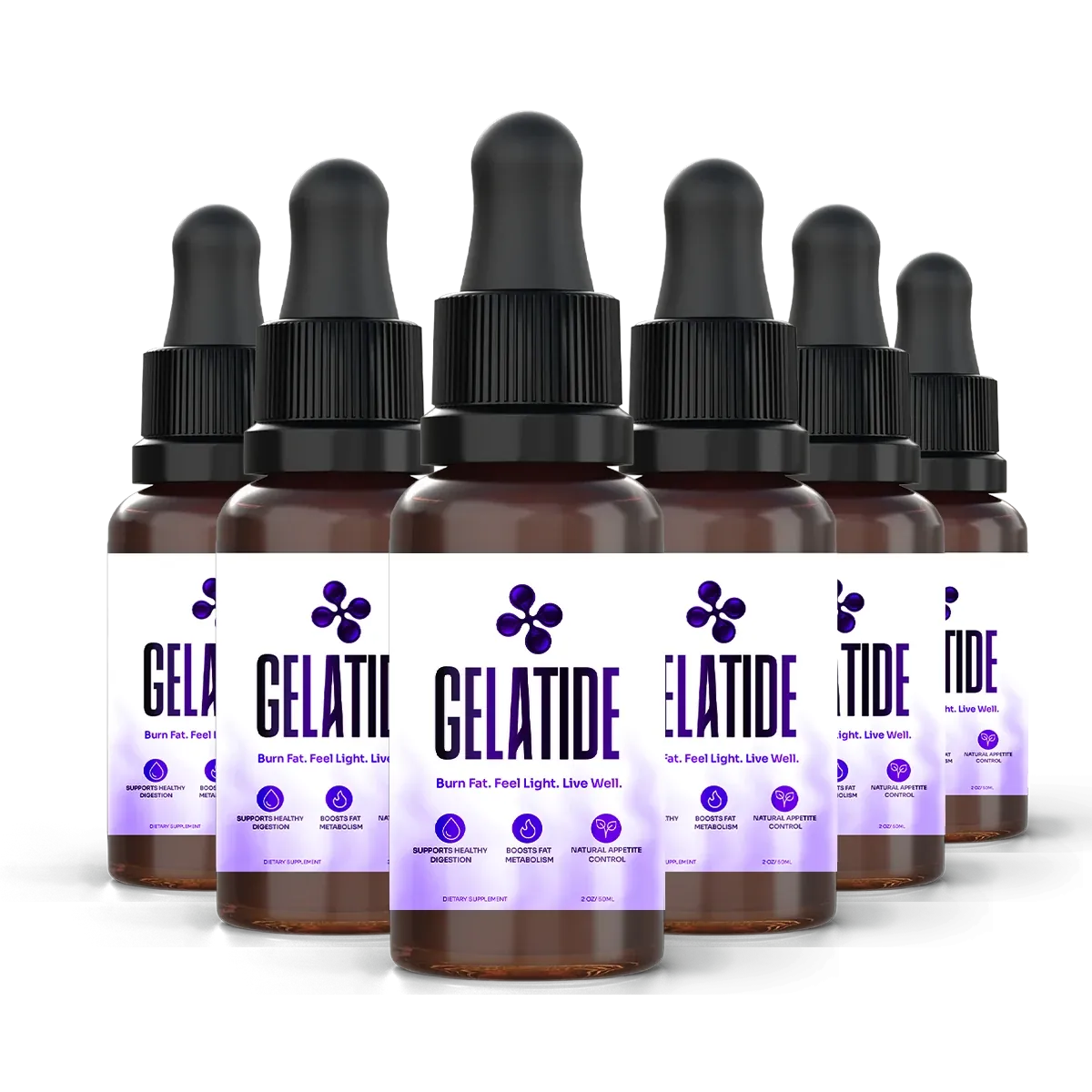
Gelatide, liquid drops, six botanicals, no printed amounts, $49 to $79 a bottle and a 60-day window. The guides above will tell you what to make of that.
$294 for six bottles at $49 each · 60 days to change your mind
Get Gelatide — $49 to $79 a bottleOne-time payment, no subscription · 60-day money-back guarantee · lot GEL-26/GE-7447 · tracking and refunds +1 (202) 604-0611